

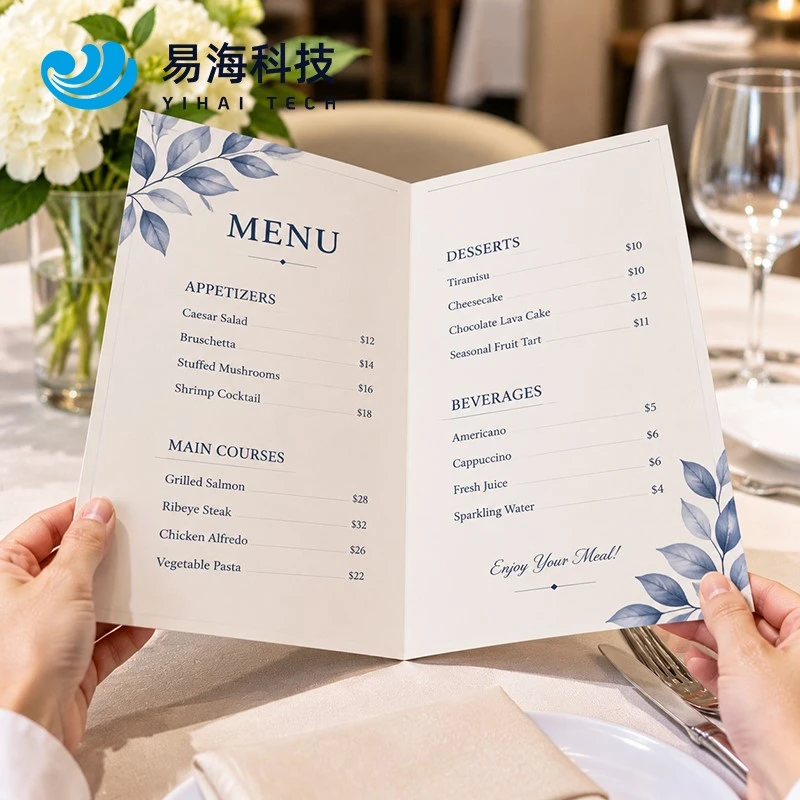
If you've ever flipped through a restaurant menu that's crumpled, stained, or torn after a few weeks of use, you know how frustrating that is-both for the venue and the customers. A lot of spots are switching to stone paper menus to fix that, but the big question I get as a stone paper supplier is what's the price tag on that upgrade? Let's break this down, no jargon, just real numbers and what affects the final cost.
First, let's clear up what stone paper menus actually are for anyone new here. Unlike regular paper (which uses wood pulp), stone paper is made mostly from calcium carbonate mined from limestone-no trees needed, that's why everyone calls it eco-friendly. It's also waterproof, tear-resistant, and holds print way better than standard paper for menus that get spilled on by coffee, wine, or appetizer sauce. If you've never looked into the raw materials, you might want to check out the Eco Friendly Mineral Paper Substrates page for a closer look at the base stuff, but for menus, it's the final product that matters most.
So, how much does a stone paper menu cost? It's not a one-size-fits-all number. I've sold to small cafes, chain restaurants, food trucks, even hotels, and prices have ranged from about $0.75 per menu for bulk orders up to $3.50 each for custom, high-end designs. The difference comes down to three main factors are size, print type and order volume.
Let's start with size first. A tiny food truck menu that's 4x6 inches is way cheaper than a full-size 8.5x11 inch restaurant menu that has 12 food items, drink specials, and a kids'section. The bigger the menu, the more raw material you need. Stone paper is priced by the sheet, so a larger sheet means more cost per unit. For example, a 10-pack of 4x6 inch stone paper sheets might cost $3, while a 10-pack of 8.5x11 is $7-so scaling up the sheet size directly drives up the base cost before even adding print.
Next, print type. This is where a lot of folks underestimate the cost difference. Most menus use UV printing because it's durable and the ink doesn't smudge even on wet surfaces. UV printing also lasts way longer than regular inkjet or offset, which is why stone paper is so popular for menus. If you want to go that route, check out the UV Printable Mineral Paper Stock page to see the specific stock that works best for UV prints. But not all printing is the same, a basic black-and-white print on a 4x6 inch menu will cost less than a full-color, glossy menu with spot UV accents, foil stamping, or die-cut shapes (like a menu cut into a pizza slice, for example). For a small cafe, a simple black-and-white UV print on stone paper might add $0.25 per menu, while a full-color, custom design with a matte finish could add $1.50 per menu. That's a huge jump just from the print job. Also, if you're printing a lot of text that's small, you'll want to make sure the stock is thick enough-we usually recommend 120 gsm for menus, since thinner (like 90 gsm) feels flimsy and tears easier after a few uses.
Then there's order volume. This is where the biggest discounts come in. If you're a small cafe ordering 50 menus for a weekend brunch pop-up, each will cost more than if a chain restaurant orders 5,000 for all their locations. For example, 50 small 4x6 inch black-and-white printed menus might be $1.00 each, but order 500 of the same, and that drops to $0.60 each. Order 2,000, and it's $0.70? Wait, no, let me correct that-usually the discount goes up as volume goes up, so 500 would be $0.70, 1,000 would be $0.55, and 5,000 would be $0.45 each. That's a massive difference. A lot of new buyers don't realize that stone paper, like most packaging and print materials, is cheaper per unit the more you buy, because we don't have to set up the press as many times and we can source the raw material in larger batches. Also, if you're ordering multiple designs at once (like separate menus for breakfast, lunch, and dinner), that might mean a separate press setup for each design, so you'll pay a little extra, but if you're consolidating orders into one design, you save on setup fees.
Wait, another factor: waterproofing. A lot of customers ask if stone paper is already waterproof, and yes, the base stone paper has some water resistance, but for menus that are regularly exposed to spills, we recommend adding an extra laminate layer. That laminate is thin, so it doesn't add much thickness, but it makes the menu completely waterproof-you can wipe a red wine stain off with a napkin and it won't leave a mark. The waterproof laminate adds about $0.15 to $0.30 per menu, depending on how many you order. If you want to see the waterproof stock we use, check out the Waterproof Mineral Printing Sheets page. For a casual diner where spills are common, that small extra cost is totally worth it to avoid having to reprint menus every month.
Now, let's talk about hidden costs that people often forget. First, shipping. If you're ordering a small number of menus, shipping might be a flat fee, which can add $10 to $20 to your total. But if you're ordering in bulk, we can usually get discounted shipping, and sometimes we even cover it for orders over a certain amount-just ask for details when you reach out. Second, custom design work. Some of our customers don't have their own graphic designer, so they pay us or a third party to create the menu layout. That can add $50 to $200, depending on how custom the design is. Third, die-cutting or folding. If you want a menu that folds in half (like a trifold) or has a unique shape (not just a rectangle), that adds a little to the cost because the cutting process requires a custom die. For example, a regular rectangular menu is standard, but a trifold might add $0.30 per menu, and a die-cut shape could add $0.50.
Wait, I should also mention the eco angle, because that's a big selling point for a lot of our customers. Stone paper is made with 80% less water than regular paper, uses no trees, and is biodegradable. That's why a lot of sustainable restaurants, farm-to-table spots, and eco-friendly hotels use it. The Eco Friendly CaCO3 Synthetic Paper page has more on the environmental benefits, but does that affect the price? A little, because stone paper was traditionally more expensive than wood pulp paper, but over the last few years, production has scaled up a lot, so the price gap has shrunk a lot. A stone paper menu is now often only 10-15% more expensive than a high-quality wood pulp menu, which is a huge change from five years ago when it was 50% more. For a restaurant that prints 1,000 menus a year, that's like a $100 difference-totally manageable.
Let me give you a real example to make this concrete. Let's say you're a small coffee shop ordering 100 5x7 inch menus, full-color print, with a waterproof laminate, no custom design, just a standard layout. What's the total cost? Let's break it down: raw stone paper sheets (100 sheets, 5x7 inch) are $3 each, print and laminate add $0.40 per menu, so total per menu is about $0.70, times 100 is $70. That's way cheaper than I thought it would be when I first started selling stone paper. Compare that to a regular laminated wood pulp menu, which would be around $0.50 per menu, so the difference is only $20 for 100 menus. That's a no-brainer for a shop that wants more durable menus.
Another example: a chain pizza place ordering 5,000 8.5x11 inch menus, full-color print, with die-cut edges (to look like a pizza box), waterproof laminate. Raw sheets are $0.12 each (since bulk), print and die-cut add $0.50 per menu, laminate adds $0.20, so total per menu is $0.82, times 5,000 is $4,100. That might seem like a lot, but if they were printing on regular paper, it would be around $0.35 per menu, so the total extra is $2,250. But they won't have to reprint these menus 2-3 times a year because of spills, tears, or water damage, so that's a huge long-term savings.
Now, what if you're a food truck that only needs 20 menus for a summer pop-up? You can still get stone paper, but the per-unit cost will be higher. 20 4x6 inch menus, black-and-white print, no laminate, would be about $1.20 each, total $24. That's a little more than regular paper, but it's way more durable for outdoor pop-ups where wind can blow menus around and rain might spot them.
I get a lot of questions about why stone paper is worth the extra cost, and it's not just durability. Customers notice the difference-stone paper has a nice, thick feel, it doesn't bend or crumple easily, and the print stays vibrant for months. For a restaurant, that means a better first impression for customers, which can lead to more orders. I've had customers tell me that switching to stone paper menus made people comment on how nice they look, and some have even asked where they can get their own. That free marketing is something you can't put a price on, right?
Another thing to consider: waste. Regular menus, especially laminated ones, are often thrown away after a few months when they get damaged, or just because restaurants want to update their menu. Stone paper is recyclable in most areas (check your local recycling guidelines) and biodegradable, so you're not contributing to extra waste. That's a big plus for businesses that are trying to reduce their carbon footprint.
Wait, are there any cases where stone paper menus are cheaper than regular paper? If you're ordering in very large volumes, sometimes yes. Because stone paper production has gotten more efficient, bulk orders of stone paper can be comparable to or even cheaper than high-quality wood pulp paper. For example, if you're ordering 10,000 menus, stone paper might be $0.40 each, while a premium wood pulp menu with laminate is $0.45 each. That's a flip from a few years ago. So it's worth asking your supplier for a quote for both to compare.
Now, let's talk about common mistakes people make when getting stone paper menus. A lot of new buyers go for the cheapest, thinnest stone paper, but that's a bad idea. Thinner (90 gsm) stone paper feels flimsy, tears easily if a customer folds it, and the print doesn't look as crisp. We always recommend at least 120 gsm for menus, because it feels like a nice cardstock, which is what customers expect for a restaurant menu. Also, don't skip the laminate for high-traffic venues. Even if you think your restaurant is low-spill, a kid might spill a soda, a server might knock over a water glass-small extra cost to avoid reprinting.
If you're still unsure about the price, the best thing to do is reach out. Every business's needs are different: small vs. large, casual vs. high-end, simple vs. custom. I can give you a customized quote based on your order size, menu size, print type, and any extra features you want. I've worked with all kinds of businesses, so I know how to balance cost with quality to get you the best value.
Wait, I should also mention that some suppliers will add setup fees for custom print jobs. For example, if you're printing a design that's not a standard template, there might be a $50-$100 setup fee. That's standard in the print industry, but it's something to factor into your total cost. If you order multiple similar designs at once, you might be able to get a discounted setup fee, so it's worth combining orders if you can.
Let me wrap this up. The price of stone paper menus isn't static-it depends on size, print, volume, and extra features, but you can expect to pay between $0.75 and $3.50 per menu, with bulk orders coming in as low as $0.45 each. The key is to figure out what your business needs: if you're a small cafe with low volume, you'll pay a little more per unit, but you get a durable, eco-friendly menu that looks great. If you're a chain restaurant with high volume, you can get a great price per unit and save money in the long run on reprints.
If you're ready to get a quote for your stone paper menus, or have more questions about the materials, just reach out. I'm here to help you figure out what works for your budget and your business. Don't forget to check out the links we mentioned if you want to learn more about the raw materials and printing options that go into your menus.
References
- Stone Paper Association. (2023). "Sustainable Applications of Calcium Carbonate-Based Paper in Hospitality." Industry Report.
- EcoLabel International. (2022). "Environmental Impact of Stone Paper vs. Traditional Wood Pulp Paper." Certification Study.
- Print Tech Digest. (2023). "UV Print Durability and Cost Comparisons for Restaurant Menus." Industry Journal.
- Hospitality Supply Chain Review. (2022). "Trends in Durable Menu Materials for Food Service Businesses." Monthly Industry Report.