

When choosing paper for printing, packaging, office supplies, labels, and other applications, buyers often compare stone paper with traditional paper. Although both materials can be supplied in rolls or sheets and used for printing and converting, their composition, production methods, and physical properties are different.
This article explains the key differences between stone paper and traditional paper and helps buyers understand which material may be suitable for different applications.
What Is Traditional Paper?
Traditional paper is generally made from wood pulp or other plant-based fibers. The manufacturing process typically involves preparing the fibers, forming a paper web with water, pressing, drying, and finishing the paper surface.
Traditional paper is widely used for:
Office paper
Books and magazines
Printing materials
Packaging
Labels
Wrapping paper
Promotional materials
Different grades of traditional paper can provide different levels of strength, smoothness, printability, and water resistance.
What Is Stone Paper?
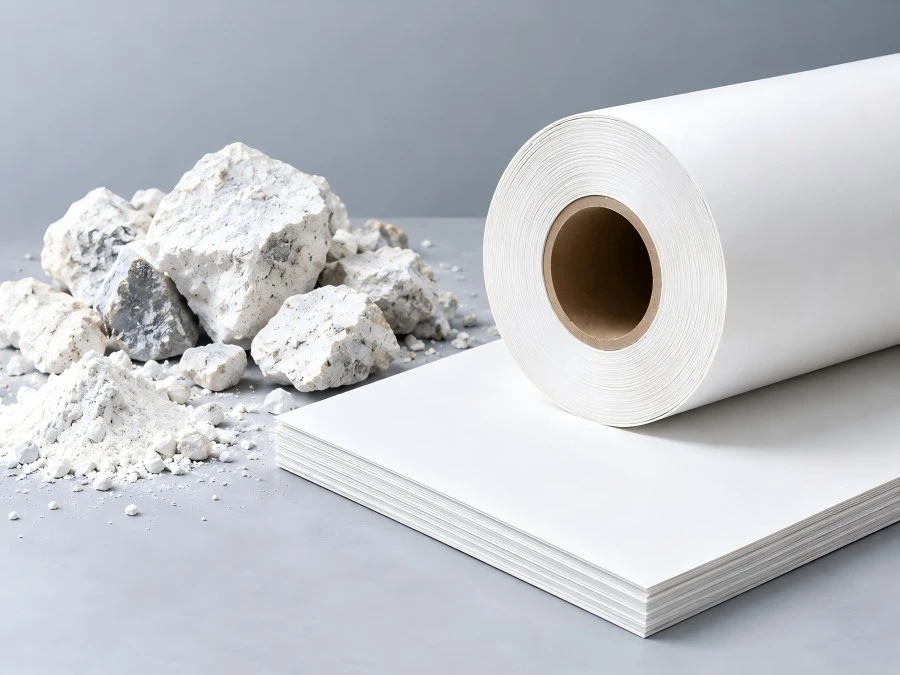
Stone paper is a mineral-based synthetic paper material made primarily from calcium carbonate powder and a polymer resin.
Unlike traditional paper, stone paper does not rely on wood pulp as its main structural material. Depending on the formulation and grade, stone paper can contain a high proportion of inorganic mineral powder combined with a smaller proportion of polymer resin and functional additives.
Stone paper can be manufactured into both rolls and sheets for applications such as:
Office paper
Printing materials
Packaging materials
Labels
Bags
Maps
Food-related paper applications
Industrial packaging
Other specialty paper products
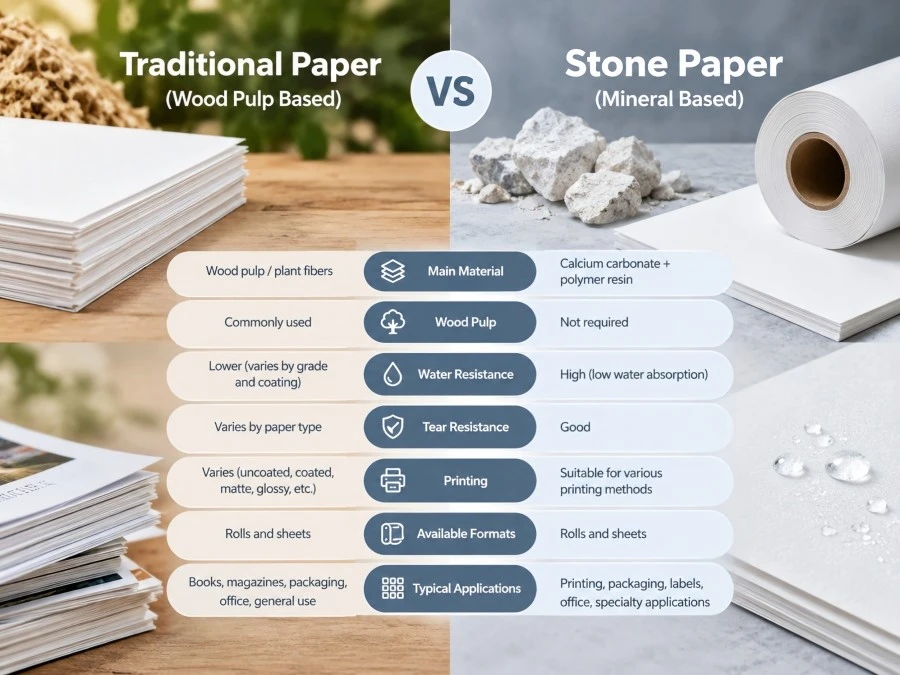
Stone Paper vs Traditional Paper: Key Differences
|
Property |
Stone Paper |
Traditional Paper |
|
Main material |
Mineral powder + polymer resin |
Wood pulp or other plant fibers |
|
Wood pulp |
Not the main raw material |
Commonly used |
|
Water resistance |
High |
Depends on paper grade and coating |
|
Water absorption |
Very low |
Generally higher |
|
Tear resistance |
Good |
Varies by paper type |
|
Surface smoothness |
Smooth |
Varies by grade |
|
Printing |
Suitable for various printing methods |
Widely printable |
|
Available formats |
Rolls and sheets |
Rolls and sheets |
|
Typical applications |
Printing, packaging, labels, office and specialty applications |
Printing, packaging, office and general paper applications |
The actual performance of either material depends on its formulation, thickness, surface treatment, and intended application.
1. Raw Materials
One of the biggest differences between stone paper and traditional paper is their basic composition.
Traditional paper mainly uses cellulose fibers obtained from wood pulp or other plant-based sources.
Stone paper uses calcium carbonate or other mineral powder as a major component, together with polymer resin and additives. This gives stone paper a structure that is different from conventional fiber-based paper.
For buyers, the distinction is important because material composition directly affects properties such as water resistance, flexibility, tear resistance, and processing performance.
2. Water Resistance
Stone paper is known for its low water absorption.
Because its structure is not based on conventional cellulose fibers, stone paper does not absorb water in the same way as ordinary paper. It can maintain its appearance and physical integrity when exposed to moisture or water for many applications.
Traditional uncoated paper, on the other hand, can absorb water relatively easily. Its water resistance can be improved through coating, lamination, or other surface treatments.
This makes stone paper a potential material choice for applications where moisture resistance is important, such as:
Outdoor maps
Waterproof labels
Packaging
Food-related applications
Industrial packaging
Certain bags and wrapping materials
3. Tear and Durability Performance
Traditional paper performance varies considerably depending on its fiber composition, basis weight, coating, and manufacturing process.
Stone paper has a dense material structure and can provide good tear resistance and durability in many applications. It can also be suitable for products that need to withstand handling, folding, or occasional exposure to moisture.
However, stone paper is not intended to replace every type of traditional paper. Application requirements such as thickness, stiffness, folding behavior, printing process, and converting equipment should be considered before selecting a material.
4. Printing Performance
Both stone paper and traditional paper can be used for printing, but their surfaces and material structures are different.
Stone paper can be processed using various printing methods depending on the specific grade and surface treatment, including:
Offset printing
Flexographic printing
Screen printing
UV printing
Digital printing
Traditional paper also supports a wide range of printing technologies and remains the standard choice for many publishing, office, and commercial printing applications.
For stone paper, buyers should select a grade designed for the intended printing process and confirm compatibility with their equipment before large-scale production.
5. Surface Properties
Stone paper generally has a smooth and relatively dense surface.
This can provide a good printing surface and a different tactile feel compared with conventional fiber-based paper.
Traditional paper can have a wide range of surface finishes, including:
Uncoated
Coated
Matte
Glossy
Textured
Embossed
Therefore, surface requirements should be considered together with printing and finishing requirements when comparing the two materials.
6. Environmental Considerations
Environmental performance should be evaluated based on the entire material life cycle rather than one characteristic alone.
Traditional paper is a fiber-based material and can be recycled through established paper recycling systems when it meets local recycling requirements. Its production, however, involves pulp processing, water use, energy consumption, and other resource requirements.
Stone paper uses mineral powder as a major raw material and does not require conventional wood pulp as its primary structural material. Its production can reduce the need for water-intensive papermaking processes compared with conventional pulp-based paper manufacturing.
At the same time, many stone paper grades contain polymer resin, so their end-of-life handling and recycling options can differ from those of conventional paper.
For this reason, buyers should evaluate factors such as raw materials, production process, product formulation, application, and local waste-management systems when assessing environmental performance.
7. Applications
Traditional paper remains suitable for a very wide range of applications, including books, newspapers, office documents, packaging, and commercial printing.
Stone paper can be considered for applications where properties such as moisture resistance, durability, and a smooth surface are important.
Typical stone paper applications include:
Office Paper
Stone paper can be manufactured into sheets or rolls for certain office and stationery applications where moisture resistance and durability are required.
Printing Paper
Stone paper can be used for printed materials such as maps, brochures, promotional materials, and specialty printed products.
Packaging Materials
Its water resistance and durability make stone paper a potential material for selected packaging applications.
Labels
Stone paper can be considered for labels that need greater resistance to moisture and handling.
Industrial Packaging
Certain stone paper grades can be used as raw materials for industrial packaging products such as bags and protective packaging.
Which One Should You Choose?
There is no single material that is suitable for every paper application.
Traditional paper may be appropriate when you need a conventional fiber-based material, established recycling infrastructure, or specific paper grades and finishing options.
Stone paper may be worth considering when your application requires properties such as:
Low water absorption
Moisture resistance
Good tear resistance
Smooth surface
Durable handling performance
Roll or sheet supply
Specialty packaging applications
The best choice depends on the specific application, printing process, thickness, required strength, environmental requirements, and converting equipment.
Stone Paper from Yihai
Yihai manufactures stone paper and other new material products for industrial and commercial applications.
Our stone paper product range includes uncoated stone paper and application-specific stone paper materials, supplied in rolls or sheets according to product requirements.
We can also provide customized material solutions based on:
Material composition
Thickness
Width
Roll or sheet format
Surface requirements
Printing requirements
Application requirements
With in-house production and technical support, we work with customers to develop stone paper materials for different applications.
Conclusion
Stone paper and traditional paper are two different types of materials with different compositions and production processes.
Traditional paper is mainly based on plant-derived fibers and remains widely used across printing, publishing, packaging, and office applications. Stone paper uses mineral powder and polymer resin to create a paper-like material with properties such as low water absorption, moisture resistance, and durability.
Rather than considering one material a universal replacement for the other, buyers should compare the materials according to their specific application requirements.
For applications where water resistance, durability, smooth surface, and alternative material composition are important, stone paper can provide another option to consider alongside traditional paper.