

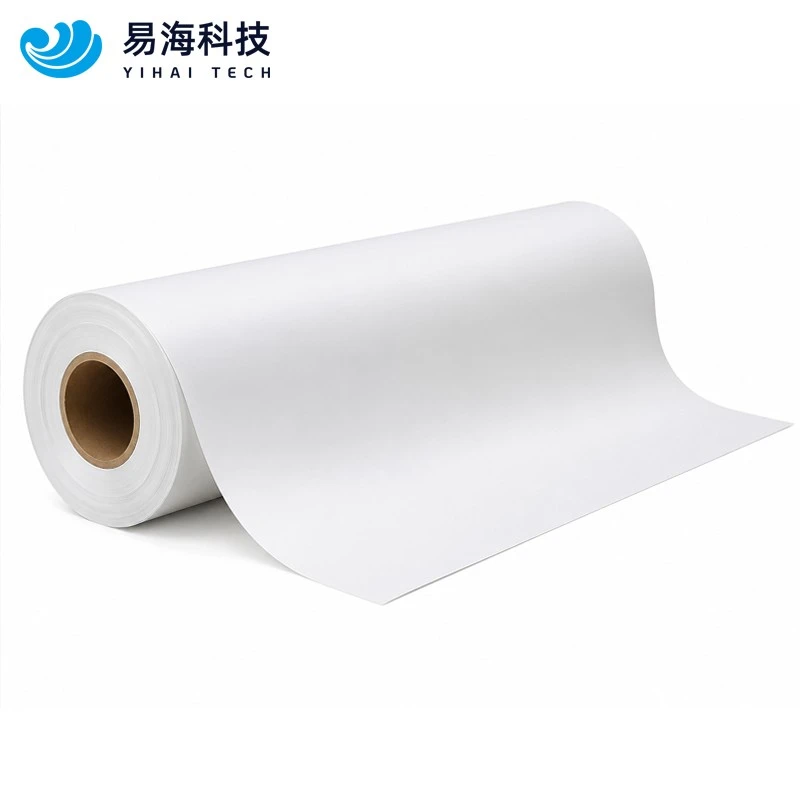
Jiangsu Jianglin Yihai New Material Science & Technology Co., Ltd. is one of the leading manufacturers and suppliers of zero plastic caco3 printing sheets in China. With abundant experience, we warmly welcome you to wholesale premium zero plastic caco3 printing sheets for sale here from our factory. All customized products are with high quality and competitive price. For quotation, contact us now.
Zero Plastic CaCO3 Printing Sheets
Mineral-based printing sheets for commercial printing, publishing, stationery, industrial documentation, and specialty printed products. The material utilizes calcium carbonate (CaCO3) as its primary mineral component and is available in sheet or roll formats tailored to converting requirements.
The relevant CaCO3 printing-sheet grades combine calcium carbonate with a polymer binder. Buyers with specific requirements for polymer content, recyclability, regulatory compliance, or environmental declarations should verify the exact material formulation and documentation for their selected grade prior to purchase.
Material and Structure
Mineral Structure
Micro-milled calcium carbonate (CaCO3) powder serves as the primary mineral filler, combined with high-density polyolefin resin systems (PP or PE) through multi-stage extrusion and forming equipment. Standard production grades achieve mineral filler loading exceeding 60% by weight.
Composition Breakdown
- Primary Mineral Component: Calcium Carbonate (CaCO3, >60%)
- Binder System: Polymer Resin (PP or PE grades)
- Product Form: Mineral-filled polymer matrix sheet
- Standard Color: White (Matte / Gloss options)
- Supply Formats: Custom Cut Sheets or Master Rolls
Material Terminology Clarification
The designation "Zero Plastic" highlights the material's primary structural reliance on natural mineral content rather than 100% synthetic polymers. It should not be interpreted as a claim that every grade contains zero polymer binder.
Material Benefits and Performance Characteristics
|
Buyer Requirement |
CaCO3 Sheet Advantage |
Technical Consideration |
|
Moisture & Weather Exposure |
100% Water-impermeable without lamination |
Prevents fluid absorption, swelling, or structural degradation |
|
Mechanical Durability |
High tear and puncture resistance |
Reduces replacement rates for heavy-use manuals and outdoor tags |
|
Wood-Pulp-Free Sourcing |
Natural calcium carbonate primary mineral base |
Treeless composition for specific sustainability directives |
|
Multi-Process Printability |
Compatible with Offset, Digital, and UV ink systems |
Engineered surface energy ensures predictable ink adhesion |
|
Workflow Flexibility |
Supplied in precision cut sheets or rolls |
Fully compatible with standard post-print converting machinery |
Technical Specifications
|
Parameter |
Technical Specification |
Test Method |
|
Material Base |
Calcium Carbonate (CaCO3) + Polyolefin Matrix |
-- |
|
Mineral Content |
60% - 80% (Grade dependent) |
ISO 2470 / TGA |
|
Binder System |
Polypropylene (PP) / Polyethylene (PE) |
FTIR Analysis |
|
Thickness Range |
100 μm - 400 μm (Customizable) |
ISO 534 / ASTM D374 |
|
Grammage (GSM) |
120 g/m² - 500 g/m² |
ISO 536 / ASTM D646 |
|
Surface Finish |
Smooth Matte / Gloss / Semi-Matte |
ISO 8254 |
|
Tensile Strength |
High Machine/Cross-Direction Balance |
ASTM D882 |
|
Tear Resistance |
High Elmendorf Tear Value |
ISO 1974 / ASTM D1922 |
|
Printing Methods |
Sheet-fed Offset, UV Offset, UV Inkjet, HP Indigo |
Trial Verified |
Printing and Processing Guidance
Offset Printing
Use quick-set or oxidative drying inks formulated for non-porous substrates. Maintain dampening water levels at the minimum operational threshold to prevent ink emulsification.
Digital Printing
Compatible with select UV-curable inkjet and digital production presses (e.g., HP Indigo certified grades). Fuser temperatures on dry-toner digital presses must be calibrated to match the thermal deformation limit of the PP/PE binder system.
UV Printing
Recommended for instant ink curing and optimal adhesion. Monitor lamp temperatures and heat-dissipation rollers to prevent thermal sheet distortion.
Converting & Finishing
- Slitting & Cutting: Use sharp carbide guillotine blades; maintain moderate pile heights to avoid compression shifting.
- Creasing & Folding: Heavy-gauge sheets (>200 μm) require pre-creasing with matrix rules to ensure clean fold lines without surface cracking.
- Die Cutting: Steel rule dies with sharp bevels yield clean edges without burring.
Target Applications
Publications: Technical manuals, field workbooks, outdoor guides, children's books, and heavy-use catalogs.
Stationery: Waterproof notebooks, durable file folders, menu covers, index tabs, and business cards.
Industrial Documentation: Machine operation manuals, safety labels, chemical drum tags, and equipment inspection logs.
Maps & Navigation: Topographic maps, nautical charts, trail maps, and outdoor signage.
Specialty Tags & Packaging: Wristbands, plant stakes, retail hangtags, and moisture-resistant packaging inserts.
Manufacturing & Quality Control
Line Specifications
- Capacity: Approx. 300 to 470 kg/hour (dependent on thickness and grade)
- Max Web Width: 1,400 mm
- Thickness Control: Online automated closed-loop gauge control (±3% variation margin)
Production Workflow
Raw Material Preparation -- Compounding & Mixing -- Extrusion -- Calendering & Forming
Final Inspection -- Packaging - Slitting / Cutting -- Thickness Gauge & Trimming
Quality Assurance Standards
- Raw Materials: Particle size distribution testing (D50/D97) of CaCO3 powder, Melt Flow Index (MFI) of resins, and moisture analysis.
- In-Process: Continuous non-contact thickness mapping, surface energy (dyne level) verification, and edge trim inspection.
- Finished Product: Tensile testing (ASTM D882), tear testing (ASTM D1922), and water resistance verification (ISO 2811).
Compliance and Documentation
Factory Management: ISO 9001 (Quality Management), ISO 14001 (Environmental Management)
Chemical Compliance: REACH (EC 1907/2006) SVHC compliance, RoHS Directive (EU 2015/863) test reports
Safety Declarations: FDA 21 CFR compliance reports for specific indirect food-contact grades; full GHS-compliant MSDS sheets.
Buyer Specification Checklist
Please supply the following parameters to receive an immediate technical quotation:
Target GSM and Thickness (μm):
- Format Requirements: Cut Sheet Dimensions (mm) or Master Roll Width (mm) x Length (m)
- Printing Method: (e.g., Offset, UV Offset, Flexo, HP Indigo, Digital Inkjet)
- Ink System & Curing: (e.g., Solvent, UV-curable, Water-based)
- Secondary Converting: (e.g., Die-cutting, Creasing, Binding)
- End-Use Environment: (e.g., Outdoor, High-Humidity, Cold Storage)
- Order Volume: Initial trial quantity and projected annual consumption
- Required Compliance Docs: (e.g., REACH, RoHS, FDA)
FAQ
Q: What is the raw material composition of CaCO3 printing sheets?
A: The sheets consist of micro-milled calcium carbonate (CaCO3) mineral powder bound within a polyolefin resin matrix (PP or PE). Natural mineral content typically ranges between 60% and 80% depending on the grade.
Q: Are these printing sheets completely plastic-free?
A: No. While natural calcium carbonate is the primary structural filler, a polyolefin binder (PP/PE) is required to form a durable sheet matrix. Buyers with strict zero-polymer requirements should review the specific Material Composition Sheet prior to ordering.
Q: Can these sheets be used on standard sheet-fed offset presses?
A: Yes, provided appropriate quick-set oxidative drying inks or UV-curable inks are used. Fountain solution levels and pile heights should be adjusted according to our technical print guidelines.
Q: How does tear resistance compare to traditional cellulose paper?
A: CaCO3 mineral sheets offer significantly higher tear, puncture, and water resistance compared to standard cellulose paper of equivalent weight, making them ideal for heavy-handling applications.
Q: Can I order sample rolls or sheets for press testing?
A: Yes. We encourage pre-production press and converting trials. Sample sheets and roll kits are available upon request to evaluate ink adhesion, drying times, and die-cutting performance.
Hot Tags: zero plastic caco3 printing sheets, China zero plastic caco3 printing sheets manufacturers, suppliers, factory, Eco Raincoat Material, Hotel Disposable Packaging Material, Printing Industrial Paper Roll, Privacy Window Film Material, stone paper, Sustainable Food Tray Paper


